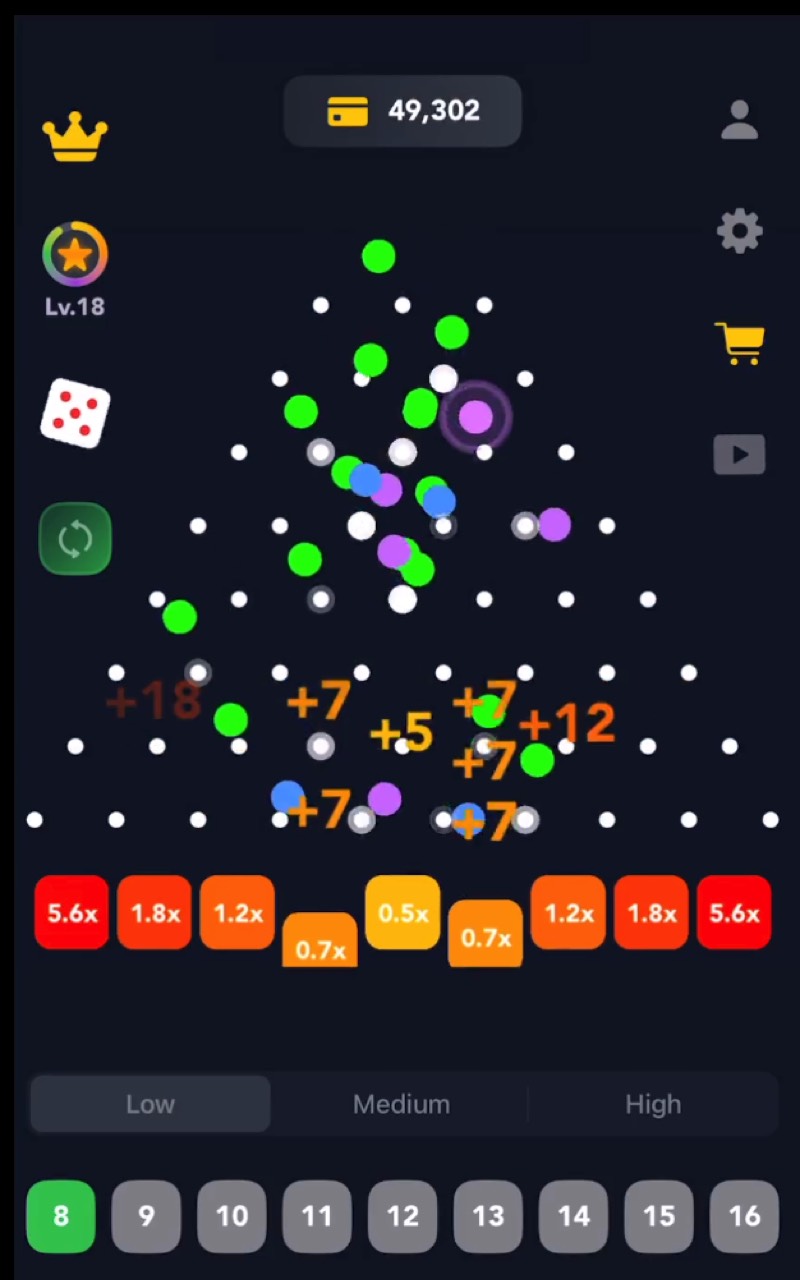
The Visual Magic of Plinko Balls
Most games rush you toward a result. Plinko does the opposite. The ball drops, and then you just... watch. There's no button to press mid-fall, no skill check, no quick-time event. You release the ball and your entire job is to follow it with your eyes as it caroms off peg after peg on its way down.
That's what hooks people. The ball moves with a weight that feels real — it accelerates under gravity, kicks sideways when it clips a peg, slows slightly at each deflection, then picks up speed again on the way to the next row. The animation isn't just decorative. It's the whole point. You're watching physics happen in miniature, and each bounce produces a tiny spike of anticipation because the ball's final destination is still unknown.
There's a rhythm to it, too. Drop, bounce-bounce-bounce-bounce, settle, payout flash. Then you drop another one. After a few rounds you'll notice you're not even thinking about the multipliers anymore — you're locked into the visual loop. The arcing trajectory off each peg, the way two balls dropped a second apart end up in completely different slots, the gradual drift toward one side of the board. It's genuinely mesmerizing in a way that screenshots don't capture.
Some players describe it as the digital equivalent of watching a marble run or a Newton's cradle. You know the physics are simple, but the emergent behavior — the specific path each individual Plinko ball carves through the grid — is unique every single time. That combination of predictable rules and unpredictable outcomes is what keeps the experience fresh across hundreds of drops.
How Each Ball Finds Its Own Path
Every Plinko ball starts at the exact same point: dead center, top of the board. From there, each one charts a completely different course. The reason comes down to a single mechanic repeated over and over: peg deflection.
When a ball hits a peg, it bounces either left or right. The direction is random — roughly a 50/50 coin flip at each peg. On a 16-row board, the ball makes 16 of these micro-decisions before reaching the bottom. That means 2 to the power of 16 possible routes, which works out to 65,536 unique paths from top to bottom.
Here's what that looks like in practice:
- Row 1: The ball hits the first peg and goes left or right. Two possible positions.
- Row 4: After four bounces, there are 16 possible routes so far. The ball could be anywhere within a small cluster near the center.
- Row 8: Now there are 256 possible paths the ball might've taken. It's starting to drift noticeably to one side or the other.
- Row 12: Over 4,000 possible routes. The ball's position on the board is clearly distinct from where another ball dropped at the same time might be.
- Row 16: The full 65,536 paths. The ball lands in one of 17 possible slots, and the specific sequence of lefts and rights that brought it there was almost certainly unique.
The beautiful part is that you can see all of this happening in real time. On normal speed, you can actually follow the ball's decision at each peg — watch it kick left, then right, then left again, building a zigzag trail down the board. Two balls dropped one after the other will diverge within the first few rows and end up in totally different slots by the bottom. It's the same starting point, the same pegs, but a completely different journey.
If the mathematics behind this distribution interests you, our Plinko crash game guide breaks down the row counts, probability tables, and multiplier math in detail.
Plinko Ball Physics at a Glance
- Drop point: Always center-top of the board
- Deflection per peg: Random left or right (~50/50)
- Rows available: 8, 9, 10, 11, 12, 13, 14, 15, or 16
- Unique paths (16 rows): 65,536
- Landing slots (16 rows): 17 multiplier buckets
- Distribution shape: Bell curve — most balls cluster near center
- Edge probability: Roughly 1 in 65,000 for the far edge on 16 rows
Slow Motion vs Instant Mode
Not everyone watches Plinko balls the same way. Some players want to savor every single bounce. Others want to blast through 500 drops in a minute and study the results afterward. That's why there are three speed modes, and choosing the right one changes the whole feel of the session.
| Speed Mode | What You See | Drops per Minute | When to Use It |
|---|---|---|---|
| Normal | Full 60fps animation — every peg hit, every arc, every bounce visible in real time | ~8–12 | When you want the full sensory experience of watching Plinko balls fall |
| Fast | Same animation at 2x speed — ball moves quicker but you can still track the path | ~20–30 | When you want visual feedback without the leisurely pace |
| Instant | No animation — ball drops and result appears immediately at the bottom | Hundreds | When you're testing a configuration or chasing a specific multiplier at volume |
Normal Speed — The Visual Sweet Spot
Normal mode is where Plinko balls really shine. You can see the ball leave the drop point, accelerate downward, clip the first peg, deflect at an angle, arc through the air to the next row, hit another peg, and repeat. The motion is smooth and satisfying. If you've ever watched a pachinko machine in a Japanese arcade, it's that same hypnotic quality — each ball carving its own little story through the pegs.
This is the mode most players use for their first dozen drops. It's also the mode people come back to when they're playing casually, because the visual experience IS the entertainment. You aren't just grinding for results; you're watching physics play out.
Fast Mode — Still Watching, Less Waiting
Fast mode doubles the animation speed. The ball still bounces off every peg and you can still follow its path, but there's less hang time between deflections. It feels snappier. Most players switch to fast mode after they've gotten comfortable with the visuals and want to see more results per session without losing the animation entirely.
Instant Mode — Pure Results
Instant mode strips out the animation completely. The ball drops and the result appears at the bottom in a fraction of a second. There are no bounces to watch, no arc to follow. It's clinical. But it's incredibly useful when you want to test how a specific risk/row combination performs over 200 or 500 drops. You can run through massive sample sizes in minutes and see the distribution pattern emerge without waiting for each individual ball to finish its journey.
Dropping Multiple Balls — Auto-Drop Explained
Dropping Plinko balls one at a time is satisfying, but watching a stream of them fall simultaneously? That's a different kind of visual experience altogether. The auto-drop feature lets you set a pace and sit back while balls rain down through the pegs continuously.
Here's how it works:
- Set your config: Pick your bet amount, risk level (low, medium, or high), and number of rows. These stay locked for the entire auto-drop run.
- Choose the count: Select how many balls you want to drop — 10, 25, 50, 100, or more.
- Hit auto-drop: The game releases Plinko balls at a steady interval. On normal speed, you'll see multiple balls on the board at the same time, each at a different stage of its descent.
- Watch the pattern form: This is the best part. After 20 or 30 drops, you'll start to see the bell curve take shape in real time. Most balls cluster in the center slots. A few stray toward the edges. The distribution builds right in front of you, ball by ball.
The visual effect of multiple Plinko balls on the board simultaneously is one of the most satisfying things about the auto-drop feature. You can see three or four balls at different heights, all bouncing independently, all headed for different slots. It looks chaotic but the underlying pattern is orderly — the bell curve always emerges given enough drops.
Auto-drop is also the most practical way to hunt for rare edge hits. If you're chasing the 1000x multiplier on high risk, you'd need to tap "drop" tens of thousands of times manually. Auto-drop does it for you. Set it, watch the balls cascade, and wait for that one ball that drifts all the way to the edge.
Auto-Drop Tips
- Normal speed + auto-drop: Best for watching the bell curve form visually
- Fast speed + auto-drop: Good balance between watching and volume
- Instant + auto-drop: Maximum throughput — use this for large sample testing
- Watch your balance: Auto-drop deducts your bet per ball, so keep an eye on credits during long runs
The Hunt for 1000x — When a Ball Hits the Edge
Every Plinko player knows the 1000x slot exists. It's right there on the board, glowing at the far edge, daring you to land in it. But watching a Plinko ball actually reach it? That's one of the most dramatic moments in the game.
Here's what makes it so rare. On a 16-row board with high risk, the 1000x multiplier sits at the very edge — the leftmost or rightmost slot. For a ball to land there, it needs to bounce in the same direction at nearly every peg. Out of 16 bounces, it might need 15 or 16 to go the same way. The probability of that is roughly 1 in 65,000.
But the visual experience of watching it happen is something else entirely:
- Rows 1–4: The ball starts drifting to one side. Nothing unusual yet — lots of balls drift early.
- Rows 5–8: It keeps going the same direction. Now you notice. The ball is further to the side than most balls ever get by this point.
- Rows 9–12: Your attention locks in. The ball is in edge territory, still bouncing the same direction. The anticipation builds with every peg.
- Rows 13–15: The ball is hugging the wall of the board. One bounce the wrong way and it falls back to a smaller multiplier. You're holding your breath.
- Row 16: The final peg. If it goes the same direction one more time... it drops into the 1000x slot. The payout flashes. The moment hits.
That slow build of tension — from casual drift to edge territory to the final peg — is what keeps players coming back and dropping more Plinko balls. Even when it doesn't hit (and statistically it won't, most of the time), the near-misses are exciting because you can see exactly how close the ball got before veering back toward center.
For a complete breakdown of every multiplier value at each risk level and row count, see the Plinko crash game multiplier tables.
Free Plinko Balls vs Real Money — Same Physics
A question that comes up constantly: do free Plinko balls behave differently from balls in real money versions? The short answer is no. The ball physics are identical. The deflection at each peg, the probability distribution, the multiplier values, the visual animation — all of it works the exact same way whether you're dropping free balls with virtual credits or using actual money on a casino site.
Here's why the free version is actually the better way to experience Plinko balls:
- You watch instead of stress: When there's no money at stake, you can actually enjoy the visual experience. You watch the ball bounce rather than anxiously calculating your balance after every drop. The sensory appeal of Plinko — the smooth physics, the satisfying deflections — comes through much more clearly when you aren't worried about losing cash.
- Unlimited drops: Free Plinko balls mean there's no limit on how many you can release. Want to run 500 high-risk drops on 16 rows to see the distribution? Go for it. Want to spend an hour on normal speed watching individual balls? Nothing's stopping you. The freedom to experiment is total.
- Same randomness, same math: The free Plinko game on Crash or Cash uses the same random number generation as real money versions. Your free Plinko ball has the exact same 1-in-65,000 chance of hitting the 1000x edge as any paid drop. The physics aren't "rigged" to be more generous just because it's free — they're identical.
- Better for learning the visual cues: After watching a few hundred free Plinko balls fall, you'll start to develop an intuition for the physics. You'll recognize early drift patterns, get a feel for how deep a ball can stay on one side before bouncing back, and understand viscerally what the bell curve looks like as it forms. That visual literacy doesn't come from reading about probability — it comes from watching balls drop.
Whether you're here to experience the visual satisfaction of Plinko ball physics or you're testing configurations before playing elsewhere, the free version gives you everything you need.
Ready to watch Plinko balls bounce? Drop your first ball now — free, no signup, no download. Just physics.
Drop Free Plinko Balls NowFrequently Asked Questions
What are blinko balls?
"Blinko balls" is a common alternate spelling for Plinko balls. It's the same game — a ball drops through a grid of pegs, bounces left or right at each row, and lands in a multiplier slot at the bottom. Whether you call them blinko balls or Plinko balls, the physics and payouts are identical. You can play the game here regardless of what you call it.
How do I get free Plinko balls?
Visit the Plinko game on Crash or Cash. You receive virtual credits automatically with no signup or deposit required. Those credits let you drop unlimited free Plinko balls at any risk level and row count. There's no limit, no daily cap, and no paywall.
Do Plinko balls have different physics on mobile?
No. The ball physics are identical on mobile and desktop. The same random number generator and deflection logic run regardless of your device. The animation is optimized for your screen size — balls scale and the board adjusts to fit — but the underlying bounce behavior, probability, and multiplier outcomes are exactly the same. A Plinko ball on your phone has the same chance of hitting the 1000x edge as one on a desktop monitor.
Can I watch Plinko balls in slow motion?
The normal speed mode shows every bounce in real time at 60 frames per second. You can follow each Plinko ball as it deflects off every peg, arcs through the air, and settles into its slot. It's the closest thing to slow motion the game offers, and it's the most visually satisfying way to play. For even more detail, watch on a larger screen where each deflection is easier to track.
How many unique paths can a Plinko ball take?
On a 16-row board, each Plinko ball makes 16 independent left-or-right bounces. That creates 2^16 possible paths — 65,536 unique routes from the drop point to the bottom. On an 8-row board, it's 256 paths. The more rows you add, the more varied the journey each ball takes, and the wider the spread of possible landing slots.
Why do most Plinko balls land in the center?
It's basic probability. To reach the center, a ball can mix left and right bounces in thousands of different combinations — any roughly equal split works. To reach an edge, it needs almost all 16 bounces to go the same direction, and there are very few combinations that produce that result. The math creates a natural bell curve: tons of paths lead to center slots, very few lead to the edges. That's why the edge slots pay 1000x and the center slots pay much less.
What's the difference between risk levels for Plinko balls?
Risk level doesn't change the ball physics — the ball still bounces randomly at each peg regardless of whether you pick low, medium, or high risk. What changes is the multiplier map at the bottom. On low risk, the center slots pay close to 1x and the edges pay modestly. On high risk, center slots pay below 1x but the edges pay up to 1000x. The ball's path is identical; only the payout structure changes.
Can I drop multiple Plinko balls at the same time?
Yes — the auto-drop feature releases Plinko balls at a steady interval so you'll see multiple balls on the board simultaneously. Each one bounces independently through the pegs. It's one of the best visual features of the game because you can watch several balls at different heights, all following their own unique paths at the same time.