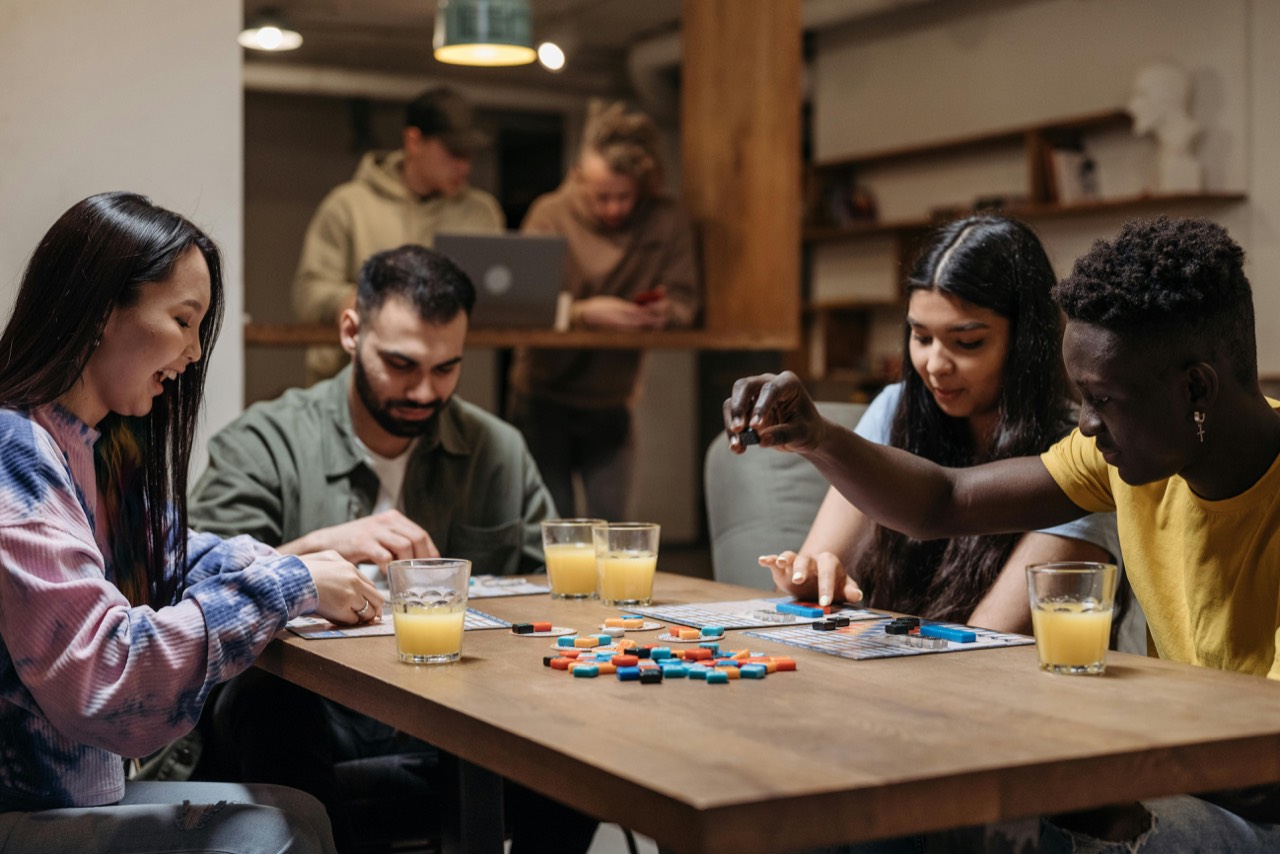
Your Brain Has a Social Play Circuit
Deep in your midbrain, there is a neural network that neuroscientist Jaak Panksepp spent 40 years mapping. He called it the PLAY circuit — one of seven primary emotional systems hardwired into every mammalian brain. Rats, dogs, dolphins, and humans all share it. When this circuit activates during social play, it triggers a cascade of neurochemicals that no other social activity replicates in the same combination.
The PLAY circuit releases dopamine (reward and motivation), oxytocin (trust and bonding), endorphins (pleasure and pain relief), and endocannabinoids (relaxation and well-being) simultaneously. Conversation activates some of these. Shared meals activate others. But only social play activates all four at once, in a sustained pattern, for the duration of the activity.
This is not a coincidence. Evolution built this circuit because social play serves critical survival functions. Animals that play together hunt together. Primates that groom and play together form coalitions that dominate those who do not. The PLAY circuit exists because our ancestors who played together survived, and those who did not were outcompeted by groups that did.
The Neurochemical Cocktail of Social Play
| Chemical | Function | Triggered By |
|---|---|---|
| Dopamine | Reward, motivation, anticipation | Unpredictable outcomes, scoring, winning |
| Oxytocin | Trust, bonding, social warmth | Shared excitement, cooperation, eye contact |
| Endorphins | Euphoria, pain relief | Laughter, physical proximity, shared celebration |
| Endocannabinoids | Calm, contentment | Rhythmic activity, flow state, prolonged play |
Mirror Neurons: Why Watching Someone Play Feels Like Playing
In the early 1990s, a team at the University of Parma accidentally discovered something extraordinary. They were monitoring a macaque monkey’s motor neurons while it reached for food. When a researcher reached for food in front of the monkey — without the monkey moving at all — the same neurons fired. The monkey’s brain was internally simulating the action it was watching.
These became known as mirror neurons, and humans have an exceptionally rich mirror neuron system. When you watch someone play a game, your brain runs a partial simulation of their actions, decisions, and emotional reactions. This is why watching a friend play a tense round is almost as exciting as playing yourself. Your mirror neurons do not distinguish between performing and observing — they fire for both.
Mirror neurons are the neurological foundation of empathy, imitation learning, and social prediction. In gaming contexts, they serve an additional function: they allow you to build a mental model of another player’s strategy, predict their next move, and coordinate your actions with theirs. This is why experienced co-op players seem to read each other’s minds — their mirror neuron systems have calibrated to each other’s patterns.
The Spectator Effect
Mirror neurons explain why gaming is one of the most popular spectator activities on the planet. The same neural mechanism that makes watching sports exciting makes watching someone play a video game exciting. Your brain is not passively observing — it is actively simulating every decision, predicting every outcome, and experiencing a muted version of every triumph and failure.
This is also why playing video games in the same room (or on a video call with screen sharing) creates stronger social bonds than playing the same game independently and comparing scores later. When mirror neurons fire in real time — when you see the player’s reaction at the same moment the outcome occurs — the social bonding effect is maximized.
Inter-Brain Synchrony: When Minds Literally Connect
The Helsinki experiment mentioned above is part of a growing field called hyperscanning — simultaneous brain imaging of multiple people during social interaction. The findings are reshaping our understanding of human connection.
When two people engage in a shared task, their neural oscillations in the alpha and theta frequency bands begin to synchronize. The more synchronized, the higher participants rate their sense of connection, trust, and enjoyment. The synchronization is strongest during activities that involve:
- Shared attention — both people focusing on the same thing at the same time
- Temporal coordination — taking turns, responding to each other’s actions
- Emotional co-regulation — experiencing similar emotions simultaneously
- Unpredictable shared outcomes — neither person knows what will happen next
Games satisfy all four conditions simultaneously. You watch the same screen, take turns or act in coordination, experience the same tension and relief, and neither player controls the random elements. This is why a 10-minute game creates more measurable inter-brain synchrony than an hour of small talk.
Social Activities Ranked by Inter-Brain Synchrony
| Activity | Synchrony Level | Why |
|---|---|---|
| Playing a game together | Very High | Shared attention + unpredictable outcomes + coordination |
| Making music together | Very High | Temporal precision + shared rhythm + emotional expression |
| Partner dancing | High | Physical coordination + shared rhythm + touch |
| Collaborative problem-solving | High | Shared goal + interdependent contributions |
| Deep conversation | Moderate | Emotional co-regulation + turn-taking |
| Watching a movie together | Moderate | Shared attention but no coordination or interaction |
| Eating together (no conversation) | Low | Physical proximity only, no shared focus |
| Texting each other | Very Low | Asynchronous, no shared sensory input |
The Evolution of Social Play
Anthropologists have studied play in every human culture ever documented — from isolated Amazonian tribes to modern urban societies — and found the same pattern everywhere: all human groups play games together. There is no known culture without group games. This universality strongly suggests that social play is not a cultural invention but a biological imperative.
Evolutionary psychologists have identified three survival functions that social play served for our ancestors:
1. Trust Calibration
In small hunter-gatherer bands, cooperation was essential but risky. You needed to know who you could trust before a real crisis. Games provided a low-stakes testing ground. How does this person handle competition? Do they play fair? Do they help weaker players? Do they gloat or share in victory? Every game session was an unconscious trust audit — and the results shaped real-world alliances.
Modern research confirms this still operates. A 2020 study in the journal Evolution and Human Behavior found that people who played cooperative games together rated each other as more trustworthy than those who had equivalent-length conversations. The effect persisted even two weeks later.
2. Social Rule Learning
Games teach social rules without real consequences. A child who cheats at tag learns that others refuse to play with cheaters. A teenager who rage-quits a board game learns that emotional dysregulation has social costs. These lessons are absorbed naturally, without lectures, because the game structure makes the consequences immediate and unmistakable.
This function is so important that play deprivation in juvenile rats produces adults who cannot read social signals, escalate conflicts unnecessarily, and fail to form stable social hierarchies. The same pattern appears in children who are denied sufficient social play — they struggle with social calibration throughout adolescence.
3. Alliance Signaling
Choosing to play with someone is a public signal of social alignment. In ancestral environments, who you played with advertised your alliances to the entire group. This signaling function persists today: inviting someone to a game night is a social statement. Being included in a gaming group confers belonging. Being excluded signals social distance.
Are Video Games Good for You? What the Science Actually Says
The debate about whether playing video games is beneficial or harmful has raged for decades. The scientific consensus as of 2025 is more nuanced than either side admits, but the evidence for social gaming is strikingly positive.
The Positive Evidence
- Social connection: A longitudinal study by Oxford’s Internet Institute found that people who played video games with friends reported higher life satisfaction than those who played solo or did not play at all.
- Cognitive benefits: Action games improve spatial attention, task-switching speed, and visual processing. Strategy games improve planning and working memory.
- Emotional regulation: Casual gaming reduces anxiety and provides healthy emotional outlets. Studies show cortisol drops during low-stakes gaming sessions.
- Team skills: Players of cooperative games show improved communication patterns and conflict resolution in workplace settings.
The Caveats
- Displacement: Gaming becomes harmful when it displaces sleep, exercise, or in-person relationships — not because of the gaming itself, but because of what it replaces.
- Isolation risk: Solo gaming for very long periods can increase loneliness. Social gaming does the opposite.
- Design matters: Games designed with manipulative monetization (loot boxes, pay-to-win) create different psychological effects than games designed for entertainment.
The key variable is not whether you play but how and with whom. Social gaming with friends or colleagues, in moderate amounts, is associated with positive outcomes across every metric researchers have measured.
Virtual Team Games: Why They Work Better Than Trust Falls
Corporate team-building is a multi-billion dollar industry built on a questionable assumption: that awkward structured activities in conference rooms create genuine connection. Research suggests they mostly create shared memories of awkwardness.
Virtual team games — where distributed teams play short online games together — are emerging as a more effective alternative, and the neuroscience explains why.
Why Traditional Team-Building Often Fails
Trust falls, rope courses, and icebreaker questions fail because they violate the conditions for genuine inter-brain synchrony. They are forced (not voluntary), awkward (triggering self-consciousness rather than flow), and unrelated to actual work dynamics. The connection formed during a trust fall does not transfer to how you communicate in a Slack channel.
Why Games Succeed Where Icebreakers Fail
Games create voluntary engagement, genuine shared attention, and authentic emotional responses. Nobody performs for a camera during a game — they perform to win or have fun. That authenticity is what the mirror neuron system reads and the social brain bonds with.
A study from MIT’s Human Dynamics Lab found that teams with high “collective intelligence” — the ability to perform well across diverse tasks — share three traits: equal conversational turn-taking, high social sensitivity, and frequent short bursts of shared activity. Games naturally create all three conditions.
Virtual Team Game Research Highlights
- Teams that played a 10-minute cooperative game before brainstorming generated 27% more ideas and rated the session as more enjoyable (Stanford, 2021)
- Remote teams that incorporated weekly 15-minute game sessions reported 34% higher trust scores after 8 weeks (Carnegie Mellon, 2022)
- New team members who played games with the group in their first week reached full productivity 11 days faster than those who did traditional onboarding only (Gallup, 2023)
The Laughter Bridge
Laughter is the most underrated social bonding mechanism in human behavior. Robert Provine, who spent 30 years studying laughter, found that we are 30 times more likely to laugh in social situations than when alone. Laughter is not primarily a response to humor — it is a social signal that communicates safety, acceptance, and shared understanding.
Games produce laughter at a higher rate than almost any other social activity. The unexpected outcomes, the friendly trash talk, the near-misses and comebacks — these create surprise and tension release cycles that are the fundamental structure of laughter. And each shared laugh triggers a burst of endorphins in both people simultaneously, deepening the bond.
This is why video games are fun in a way that conversation alone often is not. Conversation requires content — you need something to talk about. Games generate content automatically. Every round is a new micro-story. Every outcome is a reaction trigger. The social bandwidth is higher because the game is doing the heavy lifting of creating shareable moments.
Playing Together vs. Playing Alone: The Neurological Difference
Brain imaging studies reveal a clear distinction between solo and social gaming. When you play a game alone, the reward circuit (ventral striatum, orbitofrontal cortex) activates in response to wins and progress. When you play the same game with someone else present — even just watching — additional social brain regions light up.
| Brain Region | Solo Play | Social Play |
|---|---|---|
| Ventral Striatum (reward) | Active on wins | Active on wins + other’s wins |
| Temporoparietal Junction (empathy) | Inactive | Active throughout |
| Medial Prefrontal Cortex (self-other) | Low activity | High activity |
| Mirror Neuron System | Minimal | Strongly active |
| Oxytocin Release | None/minimal | Significant during shared moments |
The difference is dramatic. Social play is not just solo play with an audience — it is a fundamentally different neurological experience. The same game, played alone versus with a friend, activates different neural networks and produces different neurochemical responses. Your brain treats them as entirely different activities.
Why Online Play Counts (But Differently)
A common objection to digital gaming is that it is not “real” social interaction. The neuroscience partially supports this concern — and partially demolishes it.
Physical proximity adds three elements that screens cannot fully replicate: touch, spatial presence, and pheromone signaling. These contribute to bonding through pathways that screens bypass. This is why in-person play generally produces stronger initial bonding than remote play.
However, research on long-distance relationships and remote teams shows that shared activities matter more than physical presence for maintaining existing bonds. A 2023 study found that friends who played online games weekly maintained relationship satisfaction scores equivalent to friends who met in person monthly. The shared experience — the inter-brain synchrony, the mirror neuron activation, the shared laughter — occurs through screens, just at slightly reduced intensity.
For distributed teams and long-distance friendships, virtual games are not a compromise. They are often the only shared activity available, and something beats nothing by an enormous margin.
The 30-Second Rule: Why Simple Games Build Better Bonds
Counterintuitively, complex games do not create stronger social bonds than simple ones. Research on social play consistently finds that games with the following characteristics produce the most bonding:
- Quick rounds — short rounds mean more shared outcomes per minute, and each outcome is a bonding micro-event
- Low barrier to entry — when everyone can play immediately, nobody feels excluded or incompetent
- Visible outcomes — everyone sees the same result at the same moment, maximizing synchronized emotional responses
- Elements of surprise — unpredictable outcomes trigger the strongest shared reactions and the most laughter
This is why simple games — card games, dice games, ball-drop games, roulette spins — have been social staples for thousands of years. Their simplicity is not a limitation. It is a feature that maximizes the social bandwidth by minimizing the cognitive load.
Your brain is wired for shared play. Every game on Crash or Cash loads instantly, needs no signup, and plays in your browser — perfect for a quick round with friends, whether you are in the same room or across the world.
Explore All Free GamesFrequently Asked Questions
Are video games good for you socially?
Yes, when played with others. Neuroscience research shows that social gaming activates brain regions involved in empathy, trust, and social bonding. Shared gameplay triggers oxytocin release, synchronizes neural oscillations between players, and creates shared memories more efficiently than passive social activities like watching TV together. The key factor is playing with others, not just playing near them.
Why do humans play games together?
Social play is an evolutionary adaptation found in every human culture ever studied. Evolutionary psychologists believe shared play served three survival functions: building trust for cooperative hunting, teaching social rules without real consequences, and identifying reliable alliance partners. Modern gaming activates these same ancient neural circuits, which is why playing together feels so natural and rewarding.
Do virtual team games actually improve team bonding?
Research from MIT, Stanford, and Carnegie Mellon consistently shows that short cooperative games improve team communication, trust, and collective intelligence scores. Teams that play together before working together generate more ideas, resolve conflicts faster, and rate their collaboration more positively. The effect is strongest with games that create shared unpredictable outcomes.
What happens in your brain when you play games with friends?
Three measurable things happen simultaneously: mirror neurons fire as you observe and predict other players’ actions, oxytocin is released during moments of shared excitement or cooperative success, and your brain waves synchronize with other players — a phenomenon called inter-brain neural coupling that correlates with trust and social closeness.
Is playing video games a waste of time?
The question is not about gaming itself but about what it displaces. Social gaming in moderate amounts is associated with increased life satisfaction, better social skills, improved cognitive function, and stronger friendships. Gaming becomes a net negative only when it replaces sleep, exercise, or face-to-face connection — which is true of any activity taken to excess, not unique to games.